Poisonous Pedagogy Continued
From "For Your Own Good" by Psychonalyst Alice Miller, Deceased

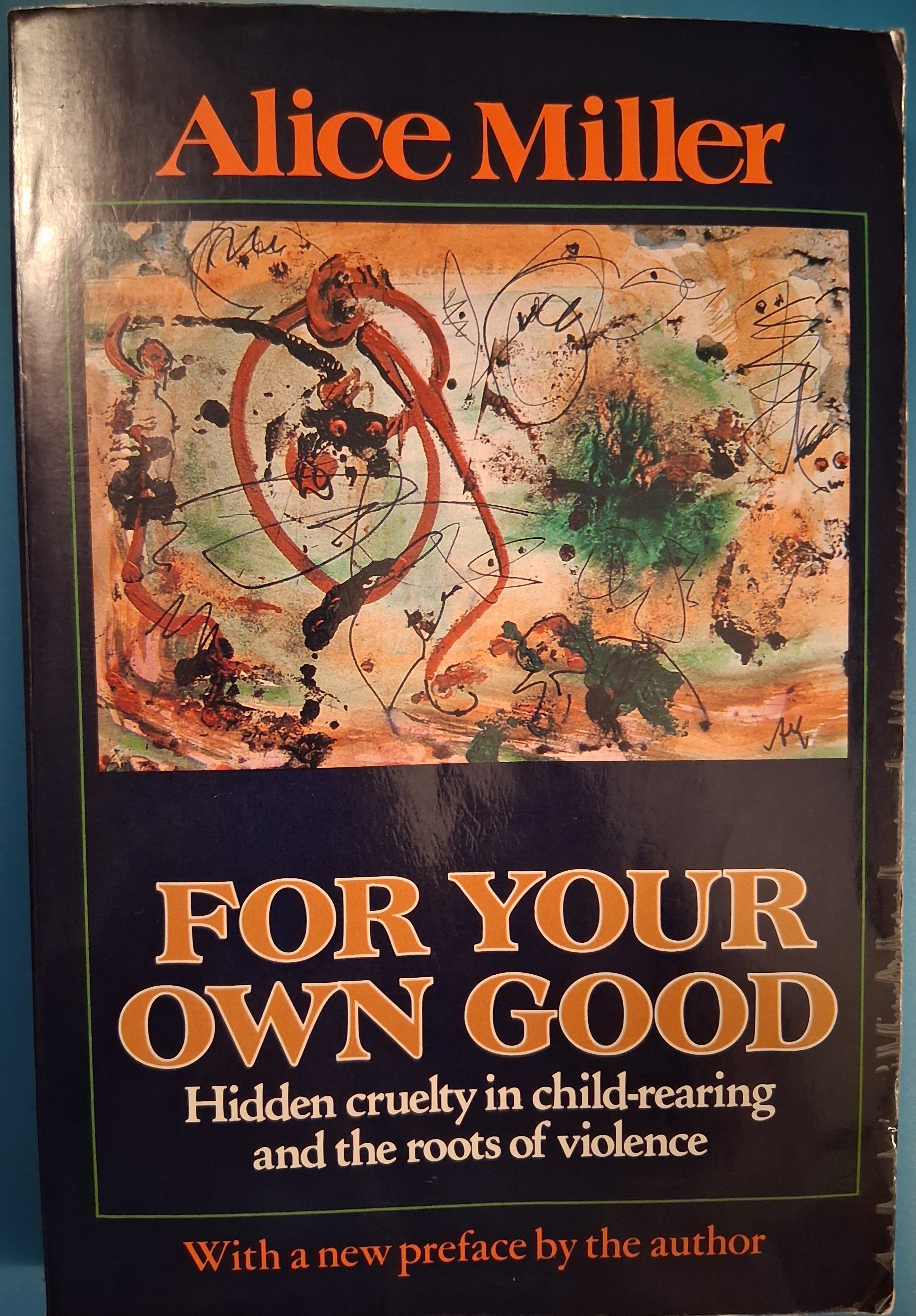
Alice Miller ends the section discussing Poisonous Pedagogy with the analysis that pedagogy was and is a method to raise children based upon the parents desire to fill their own needs. The parents look to their own life, when they were children and conceive it to have been imaginably ideal. The children are not the beneficiaries of being raised by pedagogy. Miller tells us she is against all pedagogical ideology even when the ideology is non authoritarian discipline types. She reasoned out that the care givers of children were acting out and behaving from their subconscious and that raising children can be engineered. She calls it “manipulated” through subterfuge, secret subjection causing the child to think they are in control but they are not.
Miller refered to a book called ‘Emile’ by Rousseau a pedagogical writer who said, “always let him (the child) think he is the master, but always be it yourself”, because when a child appears to be free in their own eyes, they actually are not, but are imprisoned.

“Emile” is a book written by Rousseau, pictured above detailing, how to raise children into adulthood. Miller felt that all adult training to raise children was a need felt by adults, which was the real motive, just to fulfill their need not the childs’ needs. She lists the actual adults motives as follows:
The unconscious need to pass on to others the humiliation one has undergone oneself.
The need to find an outlet for repressed affect.
The need to possess and have at one's disposal a vital object to manipulate.
Self defense: i. e., the need to idealize one's childhood and one's parents by dogmatically applying the parents’ pedagogical principles to one's own children.
Fear of freedom.
Fear of the reappearance of what one has repressed, which one reencounters in one's child and must try to stamp out, having killed it in oneself earlier.
Revenge for the pain one has suffered.
Just like the saying goes, hurt people hurt people, Alice Miller tells us that, “when children are trained, they learn to train others in turn”. Equally so the child learns ‘how to’ from being reproved, threatened, chided, insulted, shamed. This makes me question and wonder about whether or not we have really put some thought into what we want to manifest into the world. We can do that through how we treat other people, particularly, through the children. Do we want peace in this world or continuous conflicts?

Miller also has concluded that children should not be raised without any moderation. Miller's thinking and attitude toward wholesome growth emotionally and psychologically was that the child understand and practice respect for those in charge of their care. The children need to be respected also, in regards to their feelings, be cognizant of a child's needs and stressful experiences. Miller states that the parents need to be genuine, which in turn creates normal boundaries for their offspring.
If a person has not been respected as a child by their parents in ways such as, brushing aside feelings, by thinking those feelings are not important then, reject and deride them, the adult will be void of the ability to handle their children in a sensible manner, Miller explains. She analyzed that if this is the case then the parent will resort to pedagogical rule as a way to bring up their children, because the parent(s) was not cognizant of their feelings in their own childhood. When children, the parents had not been allowed to see that they had the “right” to feel their feelings. As an extension of this thought, Miller analyzed that the child has become uncertain about themselves despite the pedagogical rule.
Miller states that the child is a replacement for the care givers parents who has displayed, due to oppositional desires and anticipation, that, which will not be realized.
Miller has stated that, “I cannot attribute any positive significance to the word pedagogy. I see it as self-defense on the part of adults, as manipulation deriving from their own lack of freedom and their insecurity, which I can certainly understand, although I cannot overlook the inherent dangers. I can also understand why criminals are sent to prison, but I cannot see that deprivation of freedom and prison life, which is geared wholly to conformity, subordination, and submissiveness can really contribute to the betterment, i.e., the development of the prisoner.”
The four points that Miller unequivocally stresses what children need more generous amounts of, are these: (from page 100)
Respect for the child.
Respect for his rights
Tolerance for his feelings.
Willingness to learn from his behavior: a) About the nature of the individual child; b) About the child in the parents themselves; c) About the nature of emotional life, which can be observed much more clearly in the child than in the adult because the child can experience his feelings much more intensely and, optimally, more undisguisedly than an adult.
****************************************************
https://buymeacoffee.com/AnnBouchard
CASH APP: $Coronet9832AB
VENMO: @Ann-Bouchard-12